
Why Is My C-section Scar Itchy?
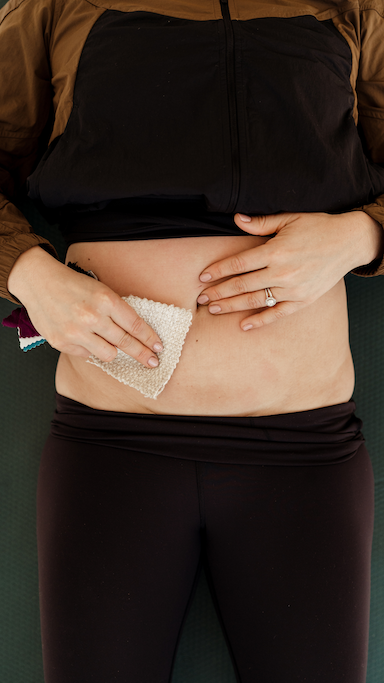
If your C-section scar is itchy, here's the reframe I want you to hear first: that itch is often a really good sign.
During your C-section, your surgeon cut through cutaneous nerves in your skin — the ones responsible for telling your brain when something feels hot, cold, tight, or ticklish. As those nerves heal and regrow, they often become itchy, tingly, numb, or oddly sensitive. It's uncomfortable, but it usually means those damaged nerves are doing exactly what they're supposed to do: growing back.
Here's the part that frustrates me as a PT: almost nobody tells moms this, and almost nobody teaches you what to do about it. You get discharge instructions about your incision staying clean and dry. You don't get told that the nerves under that incision need help reconnecting to your brain or that there's a simple, well-researched way to speed that process up and make the itching, numbness, and sensitivity resolve faster.
It's called nerve desensitization, and it's something I teach literally every single surgical patient who walks into our clinic, no matter what kind of surgery they've had. It matters that much.
What's actually happening under your scar
When a nerve is cut, it doesn't just sit there; the nerve cells go into an active regenerative state, switching on genes specifically involved in axon growth and repair. Your body is, quite literally, trying to regrow the wiring between your skin and your brain.
But regrowing the wire is only half the job. Your brain also has to relearn how to interpret the signals coming from that area and re-integrate that patch of skin back into its body map. Peripheral nerve research on cortical reorganization shows that after an area loses its normal sensory input, the brain's map of that region can become blurred or overlap with neighboring areas. That's part of why numbness, itchiness, or odd sensitivity can persist for months without the right input, your brain genuinely needs new, organized sensory information to redraw that map correctly.
That's exactly what nerve desensitization does.
Why nerve desensitization works
Desensitization isn't a folk remedy: it's a well-established rehab technique with real clinical evidence behind it:
A narrative review of rehabilitation approaches for nerve pain found that structured tactile desensitization, using graded textures against a hypersensitive area, is a recognized method for helping the brain reorganize how it processes signals from that patch of skin, reducing both pain and hypersensitivity over time.
Research specifically on cesarean scars found that structured soft tissue mobilization measurably changed the physical properties of the scar tissue and reduced pain sensitivity at the incision site.
Studies following nerve injury recovery have shown that sensory reeducation, deliberately reintroducing touch and texture to an affected area, supports better long-term sensory outcomes than simply waiting for nerves to heal on their own.
In plain terms: your nerves are trying to regrow, and your brain is trying to relearn the area. Desensitization gives both processes the structured input they need to do that faster and more completely, instead of leaving your brain to sort out confusing, inconsistent signals on its own.

How to do nerve desensitization
All you need are fabrics from around your house, ranging from soft to rough. For example cotton, silk, felt, and something rougher like a paper towel or low-grit sandpaper work well. (Our C-Section Recovery Box includes a full desensitization kit if you'd rather have it done for you.)
When to start: About one week after your C-section, once your incision is closed. Do this once or twice a day, and keep it up daily until sensation feels normal again.
How to do it:
Use a soft fabric first, and gently rub the skin around your incision, not directly on the scar yet, for about a minute.
Repeat with each texture, moving from softer to rougher.
It's going to feel strange, maybe even mildly unpleasant, especially with the rougher textures. That's normal, that odd sensation means you're stimulating the nerve, which is exactly the input it needs to heal correctly.
After 4 weeks postpartum, once you're cleared, you can move the fabrics directly over the scar itself, repeating the same soft-to-rough progression.
Make it easy to stick with: Keep your textures next to your nursing or feeding station so you can desensitize while you feed the baby. Or keep them by your bed and do it while you read or watch TV at night. It doesn't need its own dedicated 20 minutes, it just needs to happen consistently. It only takes 3 minutes but makes a major difference!
Why this matters beyond the itch
If the healing phase drags on too long without this kind of input, ongoing inflammation around the incision can lead to a buildup of restrictive scar tissue — which shows up later as pain, pulling, itching that doesn't resolve, or complications in a future pregnancy. Alongside desensitization, scar tissue mobilization, gently moving the scar and the layers beneath it in different directions once you're cleared, helps keep that tissue soft, mobile, and flat rather than thick and stuck down. We've got a full walkthrough of how and when to do that in our scar mobilization post.
This is also bigger than just the skin. Your abdominal wall needs to reconnect with your brain's movement patterns, not just its sensory map, research on post-cesarean recovery has linked disrupted core muscle activation to ongoing pain and slower functional recovery. Getting this area feeling normal again isn't just about comfort. It's part of helping your whole core come back online.
The bottom line
An itchy C-section scar usually means healing is happening, not that something's wrong. But you don't have to just wait it out! Nerve desensitization is a simple, well-supported way to help your nerves regrow and help your brain reintegrate that area faster. It's one of the first things I teach every surgical patient, and it should be standard postpartum discharge advice. It just isn't yet, so now you know.
And you don't have to figure out the timing and progression on your own. The Expecting and Empowered app has you covered from day one after your C-section through our Postpartum Strength Training – Cesarean Delivery program — a 33-week resistance training progression built specifically for C-section recovery, including guided breathing work, scar tissue mobilization, and reconnecting with your core every step of the way.
Experiencing an itchy C-section scar?
We've put together a free PDF walking you through exactly how to build and use your own desensitization kit. Enter your email below and we'll send it straight to your inbox.
Sources
American College of Obstetricians and Gynecologists. (2022). Cesarean birth. https://www.acog.org/womens-health/faqs/cesarean-birth
Gilbert I, et al. (2022). Exploring the effects of standardized soft tissue mobilization on the viscoelastic properties, pressure pain thresholds, and tactile pressure thresholds of the cesarean section scar. https://pubmed.ncbi.nlm.nih.gov/35426735/
Glatte P, et al. (2019). Architecture of the cutaneous autonomic nervous system. https://www.frontiersin.org/articles/10.3389/fneur.2019.00970/full
Renn CL, Dorsey SG, et al. Skin incision induces expression of axonal regeneration-related genes in adult rat spinal sensory neurons. PMC. https://pmc.ncbi.nlm.nih.gov/articles/PMC2955994/
Therapeutic management of the painful nerve: a narrative review of common rehabilitation interventions. (2024). https://www.oaepublish.com/articles/2347-9264.2023.78
Arikawa H, et al. (2020). Dysfunction of transversus abdominis muscle activation and its association with post-cesarean pain and recovery.
Herrmann V, et al. (2020). Adhesions after cesarean section: Current knowledge and evaluation.