
Postpartum Running Form Tips: How to Return with Confidence and Strength
So you're ready to lace up and hit the pavement—but now you're running with a different body. Whether you're 3 months or 3 years postpartum, running form matters more now than ever.
Here's how to correct your postpartum running form and prepare for running after pregnancy.
Your Postpartum Running Form Checklist
Your body deserves a thoughtful return to running, not a rushed one. Running after pregnancy isn't just about getting your lungs and legs back—it's also about reconnecting your core, pelvis, and breath with each stride.
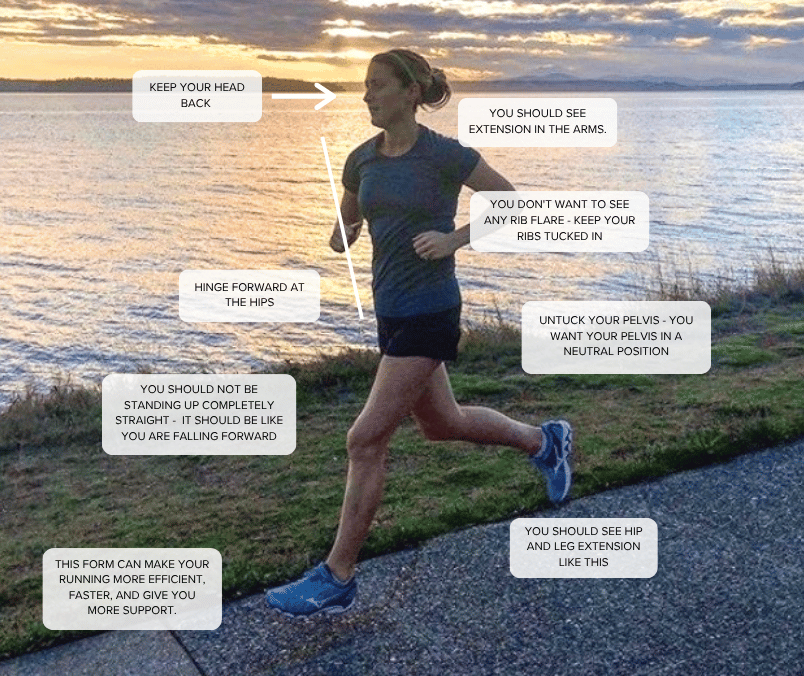
Lean Forward (Nose Over Toes)
This is one of the most underrated adjustments you can make to your postpartum running form. When you lean slightly forward (think nose over toes), you reduce the chance of overstriding and lessen heel striking. This creates smoother landings, reduces joint stress, and improves efficiency.
Bonus: This forward lean activates your posterior chain—glutes and hamstrings—which is critical for postpartum strength and support.
Use Reciprocal Rotation
Let your upper back and arms move naturally. One of the biggest mistakes postpartum runners make is running "stiff," often due to poor core connection or pushing a stroller.
As your right leg moves forward, your left arm swings forward. This activates your oblique sling—a fascia chain connecting your opposite arm and leg, helping stabilize your core and pelvis. This reciprocal movement turns your core on in a natural, efficient way—without needing to "brace" or "tuck."
Untuck Your Pelvis
Make sure you're keeping your pelvis in a neutral position. A tucked pelvis shuts off your glutes and disrupts natural movement. We need the upper body and lower body to start talking and connecting to automate your core!
How to Run With a Stroller
Running with a jogging stroller is a lifesaver for busy moms, but it can compromise your form. Holding onto the stroller with the same hand often reduces movement in your trunk. This blocks the thoracic (upper back) rotation you need to help your core fire when you run.
So, how do you run with a stroller and still keep good form? Mainly, you want to switch your stroller pushing hands often. This allows proper rotation and running form.
Other Jogging Stroller Running Form Tips:
Adjust the stroller handles so your elbow is at a 90-degree angle start position.
Alternate your hands every few minutes.
Lightly grip the handle and avoid pushing down.
When safe, run with both hands on the stroller for short periods, focusing on smooth breathing and form.
Focus on driving your free arm and chest forward and backward.
Keep your pelvis close to the stroller and keep a forward lean to your body (nose over toes).
How Soon Postpartum Can You Start Running?
Proper running form is important when you return to running postpartum. However, before you hit the ground running, it's essential to ensure your body is fully prepared for the demands of running. Running is essentially a series of single-leg jumps, and there are risks to running too soon after birth. If your muscles, joints, and core aren't up to the task, running too soon can lead to injury, leaking, or pelvic floor dysfunction.
Your body needs time to heal and strengthen before you return to running. For those reasons, we don't recommend running until at least 12 weeks postpartum. Six weeks postpartum is WAY too soon to start running again, even if your provider approves physical activity.
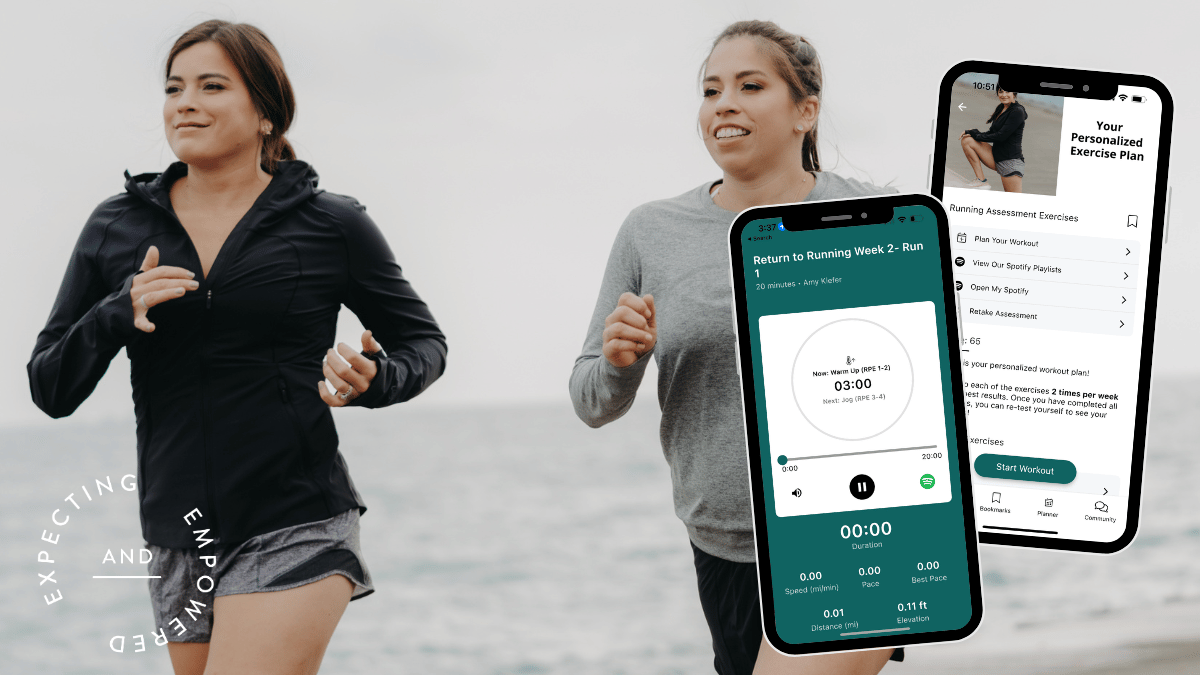
Inside the Expecting and Empowered App, you'll find our Running Readiness Assessment. This full-body checklist covers balance, impact, strength, coordination, and mobility. If you pass each test, you're cleared to run confidently. If you don't, no stress—we pair each "fail" with targeted exercises to rebuild and re-test in two weeks. One relatable example: Can you do 10 single-leg calf raises on each side? If not, let's strengthen before we return to running.
💌 Click below to sign up for a free trial of the E+E App and access the Running Readiness Assessment.
Follow Return to Running Routines for Moms
Most women take a natural break from running during the third trimester—and for good reason. Combine that time with the recovery period after birth, and you've likely had at least 6-12 weeks off from running. That means you're not "getting back to it" when you start running postpartum—you're actually starting all over again. And that's OK!
Your brain and body need to reconnect in this new phase. That means it's time to start slow. Following a structured running and strength plan will help you build the strength and mind-body connection you need.
Start with run-walk intervals. Then, gradually increase your mileage based on the acute-to-chronic workload ratio (meaning, don't spike your mileage too quickly—your body won't love it). If you're not sure where to start, the Expecting and Empowered App includes a 12-Week Return to Running Program that takes the guesswork out of postpartum running.
Make Sure You Recover Before Running After Pregnancy
Your recovery after birth—especially when returning to higher-impact movement like running—depends on more than just physical rehab. Sleep, nourishment, and your mental state also play a huge role in how your body recovers.
Get quality sleep (when you can!): Sleepsupports tissue healing, reduces inflammation, and helps restore your energy. These are all critical for postpartum strength building.
Fuel your body: Eating well gives your body the building blocks it needs to repair and rebuild, while consistent nourishment supports hormone balance and energy levels.
Don't forget mental health: High stress, anxiety, or overwhelm can increase physical tension, delay healing, and make exercise feel even harder.
Taking care of all three—rest, fuel, and emotional health—helps set the stage for a smoother, stronger return to movement. If you're unsure whether your body is ready, reach out to your healthcare provider or a postpartum physical therapy specialist for support.
JOIN THE EXPECTING AND EMPOWERED APP
Ready to run smart, strong, and symptom-free? 👉 Check out our postpartum running readiness funnel and strength-building plan inside the Expecting and Empowered App. Your postpartum body is powerful—but it's different. Returning to running isn't about bouncing back. It's about building forward. We'll help you start running again after baby with intention, alignment, and patience.
Sources
Besedovsky L, et al. (2011). Sleep and immune function. https://pmc.ncbi.nlm.nih.gov/articles/PMC3256323/
Gouin JP, et al. (2012). The Impact of Psychological Stress on Wound Healing: Methods and Mechanisms. https://pmc.ncbi.nlm.nih.gov/articles/PMC3052954/
O’Sullivan R, et al. 2016. Run kinematics with and without a jogging stroller. https://www.sciencedirect.com/science/article/abs/pii/S0966636215008966